34°c, Sunny

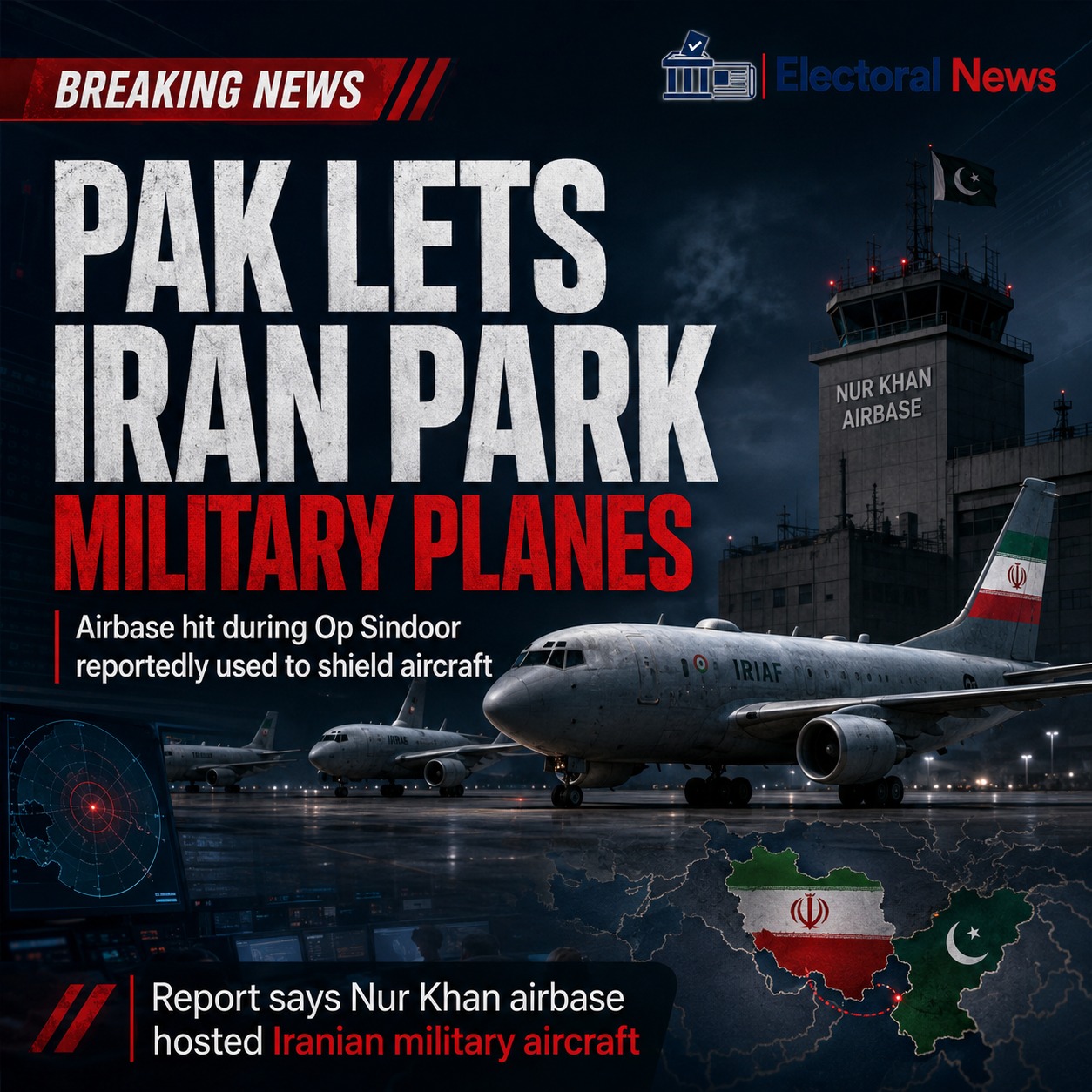
A U.S. media report has claimed that Pakistan allowed Iranian military aircraft to be stationed at Nur Khan airbase during the Iran conflict, even as Islamabad projected itself as a mediator. Pakistan has rejected the report as misleading.
A fresh international report has triggered a major geopolitical debate after claiming that Pakistan allowed Iranian military aircraft to be parked at its airbases during the recent U.S.–Iran conflict. The report said some of the aircraft were stationed at Nur Khan Airbase, a key Pakistani military facility located near Rawalpindi and close to Islamabad.According to CBS News, which was cited by several Indian and international outlets, Iran reportedly moved some of its military aviation assets to Pakistan after the escalation with the United States. The reported purpose was to protect these aircraft from possible American or Israeli strikes while Iran’s own airspace and military facilities remained under pressure.
Among the aircraft mentioned in the report was an Iranian Air Force RC-130, a reconnaissance and intelligence-gathering variant of the C-130 Hercules platform. Such aircraft are considered important in military surveillance, battlefield monitoring and intelligence operations.
The report has become controversial because Pakistan was publicly presenting itself as a mediator between Washington and Tehran during the conflict. News On AIR reported that Pakistan was playing a mediator role in the U.S.–Iran war, which it said began on February 28 and had been put on pause since April 8.
The key question now being raised is whether Pakistan was acting as a neutral diplomatic bridge or quietly helping Iran safeguard sensitive military assets. This has created a fresh credibility issue for Islamabad, especially because the reported aircraft movement happened while diplomatic efforts were underway.
Pakistan, however, has strongly pushed back against the report. The country’s Foreign Office acknowledged that Iranian military aircraft were present in Pakistan but described the U.S. media report as “misleading.” Islamabad said the aircraft arrived during the ceasefire period and had no connection to any military contingency or preservation arrangement.
Pakistan also said aircraft from both Iran and the United States had arrived during the Islamabad peace talks held on April 11 and 12. According to the Pakistani statement, the aircraft and support personnel were linked to diplomatic movement, security teams and administrative arrangements connected to the talks process.
The explanation has not ended the controversy. U.S. Senator Lindsey Graham reacted strongly to the report and said that, if accurate, it would require a complete re-evaluation of Pakistan’s role as a mediator in the conflict. His response reflects wider concern in Washington about whether Islamabad was balancing diplomacy with behind-the-scenes strategic support.
The mention of Nur Khan Airbase also gives the story an added strategic dimension for India. Nur Khan is one of Pakistan’s important military airbases and is located near Rawalpindi, close to Pakistan’s military establishment. Reports have also linked Pakistani airbases to India’s Operation Sindoor, during which Indian military officials said multiple Pakistani airfields were struck and several aircraft were destroyed.
This means the airbase is now being discussed in two separate but connected strategic contexts. First, it has been mentioned in relation to Indian strikes during Operation Sindoor. Second, it is now at the centre of reports claiming Iranian aircraft were parked there during the U.S.–Iran conflict. Together, these developments place Nur Khan Airbase at the heart of multiple regional security narratives.
For India, the report may reinforce concerns about Pakistan’s role in wider regional instability. Islamabad has traditionally maintained strong ties with both China and Gulf actors, while also balancing its relationship with the United States. The latest claim suggests that Pakistan may be trying to position itself as a mediator, while simultaneously keeping strategic channels open with Iran.
From Pakistan’s point of view, the situation is diplomatically sensitive. If it is seen as helping Iran protect military assets, that could complicate its relationship with Washington. If it is seen as cooperating too closely with the United States, it could weaken its credibility with Iran. This is why Pakistan’s official clarification appears aimed at limiting diplomatic damage.
The Afghanistan angle has also been mentioned in reports. NDTV, citing the CBS report, said Iran also parked some civilian aircraft in Afghanistan, though it was unclear whether military planes were included in those movements. Afghan officials reportedly said one Iranian civilian aircraft landed in Kabul before the conflict and remained there for some time because Iranian airspace had been closed.
The controversy highlights how modern conflicts are no longer limited to direct battlefields. Aircraft movement, airbase access, logistics, intelligence platforms and diplomatic mediation are all part of the larger strategic game. A country can publicly call for peace while still facing questions over what it allowed behind the scenes.
The report also comes amid growing scrutiny of Pakistan’s regional role. In recent months, Pakistan has tried to present itself as a diplomatic bridge in West Asia. But if allegations of hosting Iranian military aircraft gain wider attention, that mediator image could be challenged.
At the same time, it is important to note that the core claim remains based on media reporting and has been disputed by Pakistan. Islamabad has not denied the presence of Iranian aircraft entirely, but it has rejected the interpretation that they were parked for military shielding or preservation purposes.
The issue may now depend on whether more evidence emerges. Satellite imagery, official statements, aircraft tracking records or further U.S. disclosures could determine whether the story becomes a passing controversy or a larger diplomatic crisis.
For now, the development has three major implications. It raises doubts about Pakistan’s neutrality in the U.S.–Iran conflict. It places Nur Khan Airbase back in strategic focus. And it adds another layer to the already complex India–Pakistan–Iran–U.S. security equation.
Key Highlights
- Pakistan reportedly allowed Iranian military aircraft to be parked at Nur Khan Airbase during the U.S.–Iran conflict.
- The report said an Iranian RC-130 reconnaissance aircraft was among the aircraft moved to Pakistan.
- Pakistan acknowledged the presence of Iranian aircraft but rejected the report’s interpretation as misleading.
- U.S. Senator Lindsey Graham called for a re-evaluation of Pakistan’s mediator role if the report is accurate.
- Nur Khan Airbase has also been discussed in connection with India’s Operation Sindoor strike narrative.