34°c, Sunny

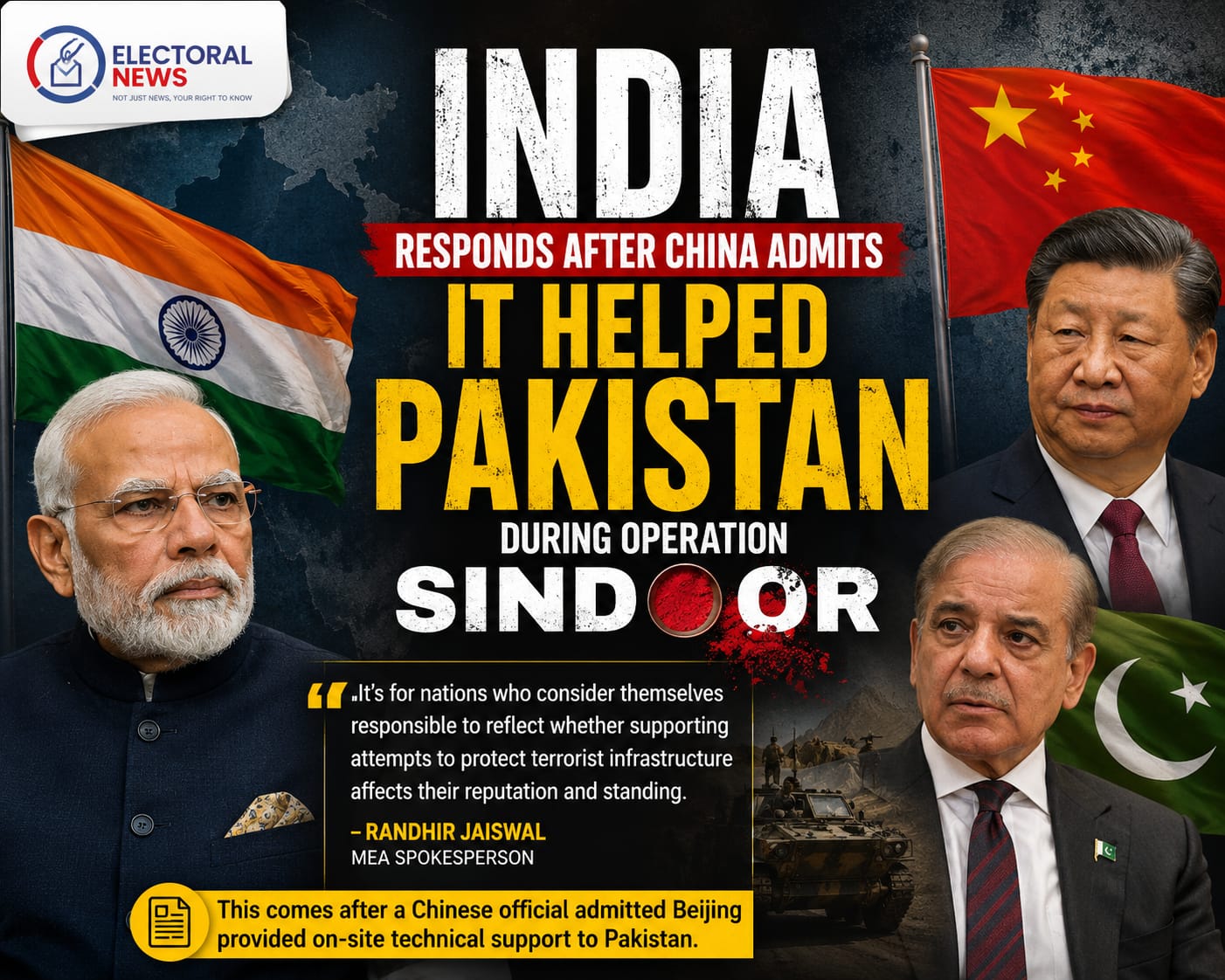
India has issued a strong diplomatic response after reports claimed China provided on-site technical support to Pakistan during Operation Sindoor, with the MEA saying responsible nations must reflect on whether such actions affect their reputation and standing.
India has reacted sharply to reports that China provided technical support to Pakistan during Operation Sindoor, a military operation launched by India after the Pahalgam terror attack. The Ministry of External Affairs said the latest reports only confirm what India had already known about external support to Pakistan during the conflict.MEA spokesperson Randhir Jaiswal said India had seen reports that “corroborate what was known earlier.” He described Operation Sindoor as a “precise, targeted and calibrated response” to the terrorist attacks in Pahalgam, aimed at destroying state-sponsored terrorist infrastructure operating from Pakistan and at Pakistan’s behest.
Jaiswal also delivered a strong message without directly naming China, saying that nations which consider themselves responsible should reflect on whether supporting attempts to protect terrorist infrastructure affects their reputation and standing. His remarks came after reports citing Chinese official media said Beijing had provided on-site technical support to Pakistan during the conflict.
The development has added a serious diplomatic angle to Operation Sindoor. Until now, the operation was mainly discussed in the context of India’s military response to Pakistan-backed terror infrastructure. With reports of Chinese technical assistance to Pakistan, the issue has now expanded into a broader regional security question involving India, Pakistan and China.
According to reports, Chinese official media referred to technical support provided to Pakistan during the four-day conflict. The Week reported that China’s state broadcaster CCTV aired an interview involving Zhang Heng, an engineer linked to the Aviation Industry Corporation of China’s Chengdu Aircraft Design and Research Institute, with reports saying he had provided technical support to Pakistan.
For India, this is significant because it strengthens New Delhi’s long-standing concern about the strategic and defence relationship between China and Pakistan. The China-Pakistan defence partnership has been closely watched by Indian security planners for years, especially in the context of aircraft systems, missile technology, surveillance capability and battlefield coordination. The latest reports are likely to deepen Indian concerns about a two-front security challenge.
Operation Sindoor itself was presented by India as a calibrated action against terror infrastructure. Reports said it followed the Pahalgam terror attack and was intended to target infrastructure operating from Pakistan and Pakistan-occupied Kashmir. India’s position has been that the operation was not aimed at civilian targets but at terror-linked facilities.
The MEA’s latest response also appears designed to put diplomatic pressure on China. By using the phrase “reputation and standing,” India has framed the issue not only as a security matter but also as a question of global responsibility. The message suggests that countries claiming to be responsible international actors cannot ignore the consequences of supporting a state accused by India of sheltering terror infrastructure.
This statement may also have wider diplomatic implications. India has been trying to build stronger security partnerships with countries concerned about terrorism, maritime security and Indo-Pacific stability. If China’s role during Operation Sindoor becomes a larger international discussion, New Delhi may use the issue to highlight what it sees as Beijing’s role in strengthening Pakistan’s military position during moments of conflict.
The issue also comes at a sensitive time for India-China relations. While both countries have attempted to manage tensions through diplomatic channels, strategic trust remains fragile. Any report of Chinese support to Pakistan during a military confrontation with India is likely to complicate efforts to stabilise ties between New Delhi and Beijing.
From Pakistan’s perspective, Chinese support would be seen as part of its long-standing strategic partnership with Beijing. But from India’s point of view, such assistance during an active conflict raises questions about neutrality, regional escalation and the role of external powers in protecting Pakistan’s military or terror-linked infrastructure.
The latest remarks from India also underline a larger strategic message: New Delhi is unwilling to treat terrorism-related security issues as bilateral India-Pakistan matters alone when external actors are believed to be involved. By pointing to China’s reported role, India is signalling that regional conflicts cannot be separated from the broader geopolitical support systems behind them.
The controversy is likely to remain part of India’s security and diplomatic discourse in the coming days. If more details emerge about the nature of the reported technical support, the issue could lead to stronger political reactions, deeper defence analysis and renewed debate on India’s preparedness for coordinated threats from Pakistan and China.
For now, India’s response is clear: Operation Sindoor was a targeted counter-terror response, and any support given to Pakistan during that operation will be judged through the lens of responsibility, reputation and regional stability.
Key Highlights
- India says reports of Chinese support to Pakistan during Operation Sindoor confirm what was already known.
- MEA spokesperson Randhir Jaiswal said responsible nations must reflect on whether supporting attempts to protect terrorist infrastructure affects their reputation and standing.
- Reports citing Chinese official media said China provided on-site technical support to Pakistan during the conflict.
- The issue adds a new diplomatic and strategic layer to India-China-Pakistan relations.