34°c, Sunny

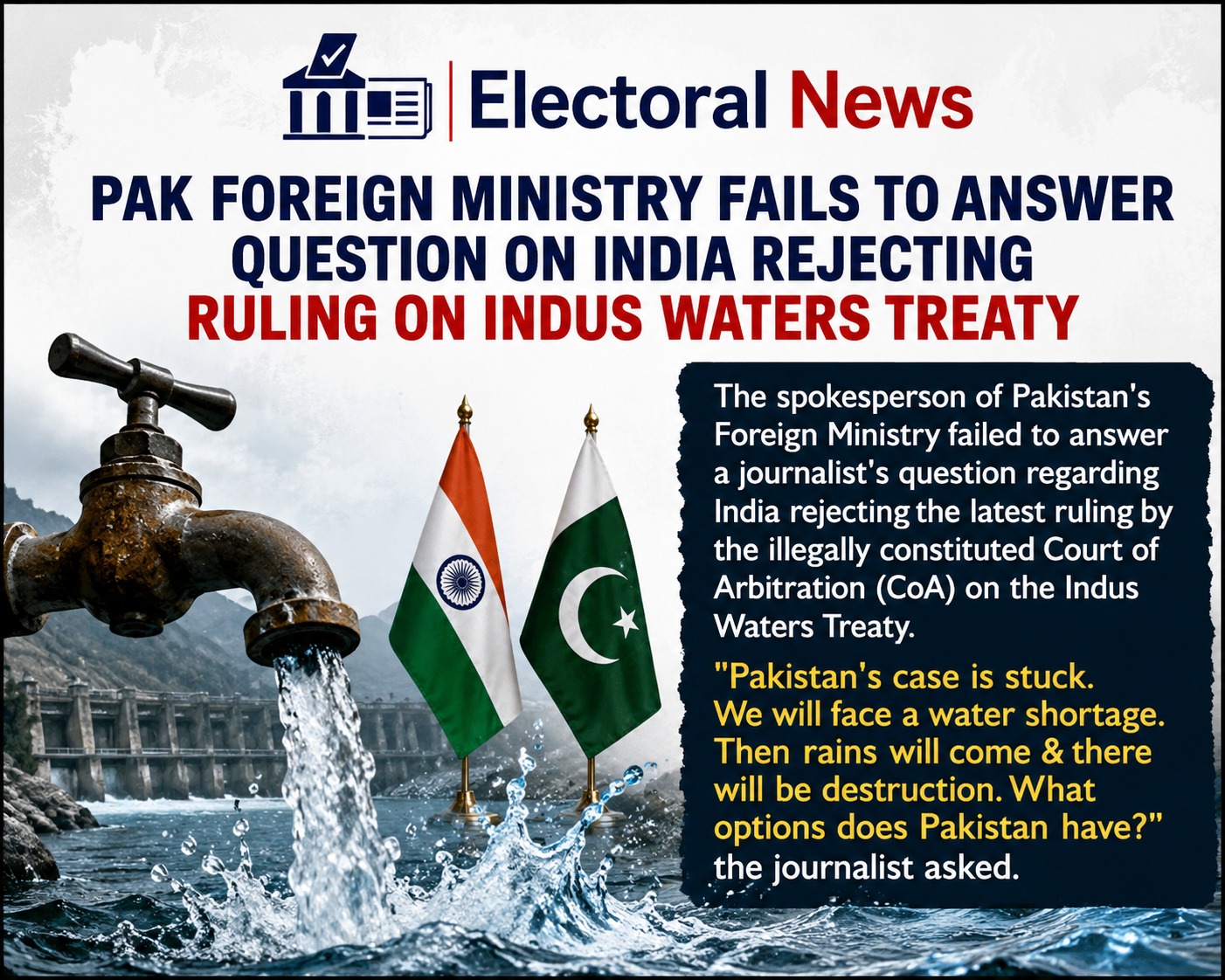
Pakistan’s Foreign Ministry reportedly struggled to respond to a journalist’s question after India rejected the latest Court of Arbitration ruling on the Indus Waters Treaty, calling the tribunal “illegally constituted” and its award “null and void.”
Pakistan’s Foreign Ministry has come under attention after a journalist reportedly questioned the government’s position on the Indus Waters Treaty, following India’s rejection of the latest ruling by the Court of Arbitration.The question raised concern over Pakistan’s options after India rejected the arbitration award. The journalist reportedly pointed out that Pakistan’s case appears stuck, while the country could face water shortages and later monsoon-related destruction. The exchange has triggered discussion on Pakistan’s diplomatic, legal and water-security options.
India, meanwhile, has firmly rejected the latest award issued by the Court of Arbitration on matters related to the Indus Waters Treaty. The Ministry of External Affairs said India has never recognised the establishment of what it called the “so-called Court of Arbitration” and added that any proceeding, award or decision issued by it is “null and void.” India also stated that its decision to keep the Indus Waters Treaty in abeyance remains in force.
The dispute has once again brought the 1960 Indus Waters Treaty into the spotlight. Brokered by the World Bank, the treaty allocates the western rivers — Indus, Jhelum and Chenab — to Pakistan, while the eastern rivers — Ravi, Beas and Sutlej — are allocated to India. The treaty also permits certain limited uses by each country on rivers allocated to the other side.
For decades, the treaty was seen as one of the few agreements that survived repeated India-Pakistan tensions. However, recent developments have pushed the water-sharing arrangement into a new crisis. India had earlier decided to hold the treaty in abeyance following a major terror attack in Kashmir, a move that Pakistan strongly opposed. Reuters reported that the treaty remained suspended despite a ceasefire between the two countries.
The latest controversy centres on the Court of Arbitration process. Pakistan has relied on international arbitration to challenge India’s position on treaty-related disputes, especially involving hydropower projects and water management. India, however, has repeatedly argued that the arbitration mechanism was wrongly constituted and has refused to recognise its authority.
New Delhi’s position is that proceedings from the Court of Arbitration cannot bind India because it does not accept the tribunal’s legitimacy. This is why India rejected the latest award concerning maximum pondage, saying the decision has no legal effect from India’s point of view.
For Pakistan, the issue is extremely sensitive because the Indus river system is deeply connected to its agriculture, drinking water supply and food security. Reuters has reported that the treaty historically governed water supplies vital to a large share of Pakistan’s farmland.
The reported question at Pakistan’s Foreign Ministry briefing reflects this anxiety. If India refuses to recognise the arbitration ruling and continues to keep the treaty in abeyance, Pakistan may face a difficult diplomatic situation. Its options may include continuing international legal pressure, seeking support from global institutions, raising the issue at multilateral forums, or pushing for renewed bilateral engagement.
However, India’s current position appears firm. The MEA has linked the treaty issue to Pakistan’s continued support for cross-border terrorism and has maintained that normal treaty arrangements cannot continue under the existing security environment. India has also rejected third-party pressure in the dispute, arguing that the arbitration route cannot override its sovereign decision.
The situation also has a seasonal dimension. Water concerns become more politically sensitive during periods of shortage, while monsoon rains can create the opposite challenge of flooding and reservoir management. This makes the treaty dispute not only a diplomatic matter but also a practical water-management issue for both countries.
From India’s perspective, the dispute is tied to national security and treaty compliance. From Pakistan’s perspective, it is tied to water availability, agriculture and economic stability. This makes the Indus Waters Treaty one of the most sensitive issues in South Asia.
The latest exchange also shows how public pressure inside Pakistan may grow if water insecurity becomes a larger concern. When journalists begin asking what options the country has left, it signals that the issue is moving beyond legal arguments and entering domestic political debate.
For now, the diplomatic deadlock continues. India has rejected the arbitration ruling, Pakistan continues to contest India’s position, and the future of the Indus Waters Treaty remains uncertain.
Key Highlights
- Pakistan Foreign Ministry reportedly faced a tough question over India’s rejection of the Indus Waters Treaty arbitration ruling.
- India called the Court of Arbitration “illegally constituted.”
- India said any award issued by the tribunal is “null and void.”
- The Indus Waters Treaty remains in abeyance from India’s side.
- Pakistan faces pressure over water security, agriculture and legal options.
- The dispute has become a major India-Pakistan diplomatic flashpoint.