34°c, Sunny

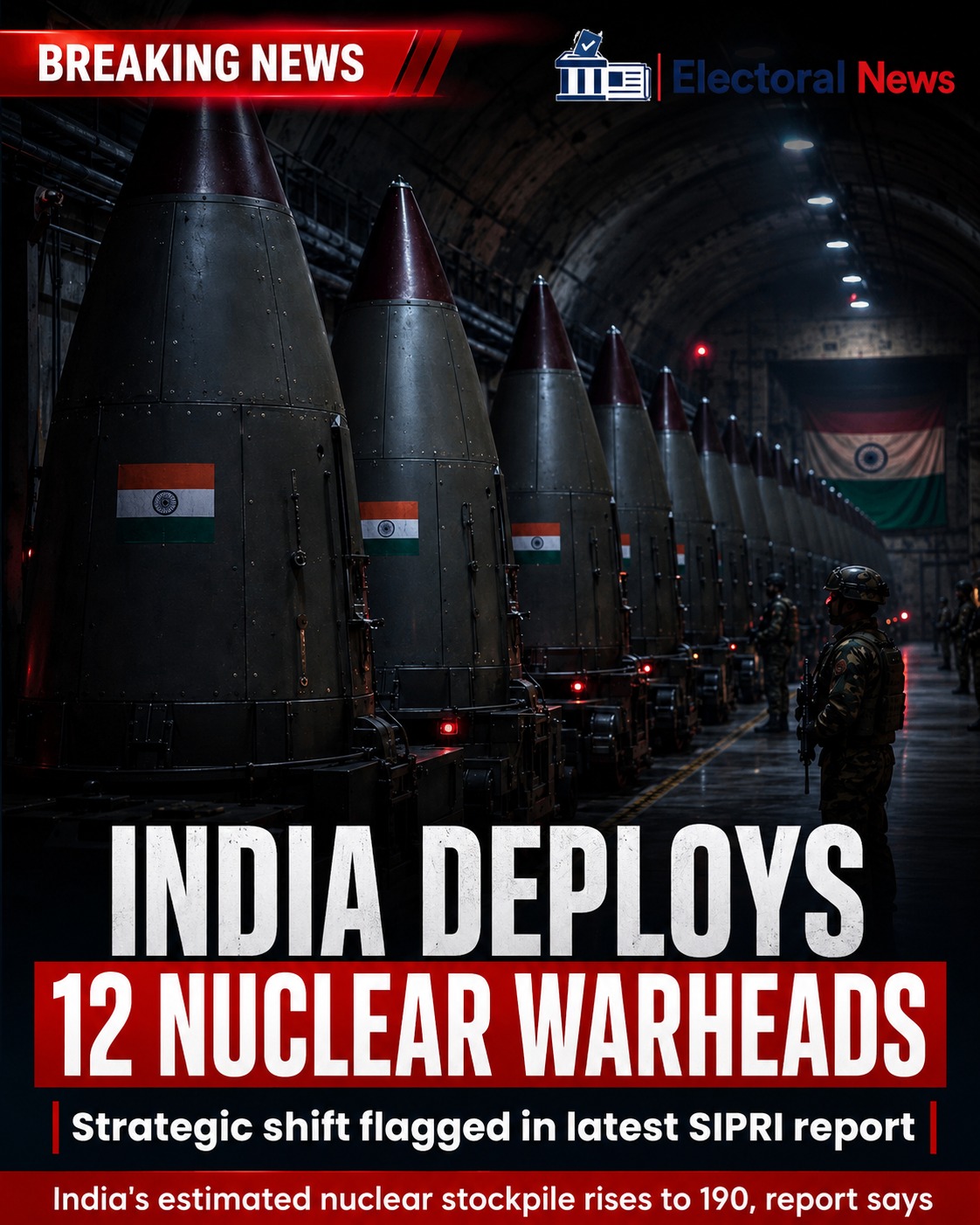
A latest SIPRI-linked assessment says India has operationally deployed 12 nuclear warheads for the first time, marking a major change in the way India’s nuclear arsenal is classified. India’s total nuclear stockpile is estimated at 190 warheads.
India’s nuclear posture has come under renewed global attention after a latest assessment by the Stockholm International Peace Research Institute indicated that India has, for the first time, operationally deployed a small number of nuclear warheads. According to reports citing SIPRI’s latest assessment, India is estimated to have a total nuclear arsenal of 190 warheads as of January 2026. Out of this, 12 warheads are assessed to be deployed. This marks the first time India’s nuclear arsenal has been classified as partly operationally deployed rather than entirely stockpiled. The reported development is significant because India has long been understood to follow a cautious peacetime nuclear posture, where nuclear warheads and delivery systems were stored separately. Such a posture was viewed as a confidence-building measure and as part of India’s broader doctrine of minimum credible deterrence. The latest assessment suggests a possible shift in operational readiness. Deployed nuclear warheads generally mean that warheads are either mated with delivery systems or placed in a condition where they are available for military use at a higher level of readiness than stockpiled weapons. However, it is important to note that this is an external assessment by SIPRI and reported by media outlets. There has been no official Indian government confirmation that India has changed its nuclear deployment policy.India’s nuclear doctrine has traditionally been based on two major principles: No First Use and credible minimum deterrence. Under the No First Use doctrine, India states that it will not be the first to use nuclear weapons, but reserves the right to respond with nuclear retaliation if attacked with nuclear weapons. The reported deployment therefore does not necessarily mean a change in India’s declared doctrine. Instead, defence analysts are likely to view it as a change in posture, readiness, or classification of some nuclear assets within India’s broader deterrence structure. The timing of the report is also important. Global nuclear tensions have been rising, with major nuclear-armed states modernising their arsenals. SIPRI’s latest global assessment says nuclear-armed countries are increasingly relying on nuclear weapons as instruments of national power, reversing decades of efforts to reduce the role of nuclear weapons in security strategy. India’s modernisation is also taking place in a complex security environment. India faces two nuclear-armed neighbours: Pakistan and China. India’s nuclear planning has historically focused heavily on Pakistan, but in recent years, analysts have noted growing attention toward long-range delivery systems capable of reaching targets across China. The SIPRI assessment also says India continued development of new types of nuclear delivery systems in 2025. This indicates that India is not only expanding numbers slightly but also improving the range, survivability and flexibility of its nuclear forces.
One of the most important elements in India’s nuclear modernisation is the sea-based deterrent. Nuclear submarines give a country second-strike capability, meaning the ability to respond even after suffering a nuclear attack. For a No First Use country like India, survivable second-strike capability is central to deterrence credibility. If a portion of India’s warheads is now considered deployed, it may indicate a greater focus on readiness and survivability. It may also reflect changing threat perceptions after recent regional tensions and broader global instability. Pakistan is estimated to have around 170 nuclear warheads, while India’s stockpile is now assessed at 190. This places India slightly ahead of Pakistan in total estimated warhead count, though nuclear balance is not only about numbers. Delivery systems, survivability, command-and-control, doctrine, and escalation management are equally important. China, meanwhile, is rapidly expanding and modernising its nuclear arsenal, which has become a growing concern for both India and the wider international community. India’s long-range missile development is increasingly seen through the lens of China-focused deterrence.
The latest report could therefore be read as part of a broader strategic adjustment. India may be seeking to ensure that its nuclear deterrent remains credible against both Pakistan and China, while still officially maintaining its No First Use policy. At the same time, nuclear deployment always carries risks. Higher readiness can strengthen deterrence, but it can also increase the risk of miscalculation during crises. In South Asia, where India and Pakistan have a history of sudden escalation, any shift in nuclear posture will be closely watched by global security experts. SIPRI’s broader warning is that nuclear risks are rising worldwide. The weakening of arms-control agreements, modernisation of nuclear forces, and growing geopolitical rivalry have all contributed to a more dangerous global nuclear environment. For India, the key challenge will be balancing deterrence credibility with strategic restraint. The country’s official nuclear doctrine has been built around responsible behaviour, No First Use, and minimum deterrence. Any operational changes will be analysed in that context.
The reported deployment of 12 warheads does not automatically mean India is preparing for nuclear conflict. Rather, it suggests that part of India’s nuclear arsenal may now be maintained at a higher level of operational readiness than before. This development will likely trigger debate among defence analysts, policymakers and regional security observers. Supporters may argue that India needs stronger readiness because of growing threats from China and Pakistan. Critics may warn that deployment can increase escalation risks in a tense region. For now, the central point is clear: SIPRI’s latest assessment marks a notable moment in India’s nuclear posture. Whether this reflects a formal policy shift, an operational adjustment, or a change in classification, it has placed India’s nuclear deterrence strategy back at the centre of national security discussion.
Key Highlights
- SIPRI-linked reports say India has operationally deployed 12 nuclear warheads for the first time.
- India’s total nuclear stockpile is estimated at 190 warheads.
- The assessment marks a shift from India’s traditional posture of keeping warheads and delivery systems separate.
- India continues to officially follow a No First Use doctrine.
- The development comes amid rising global nuclear tensions and regional security concerns.
- China and Pakistan remain central factors in India’s nuclear deterrence planning.