34°c, Sunny

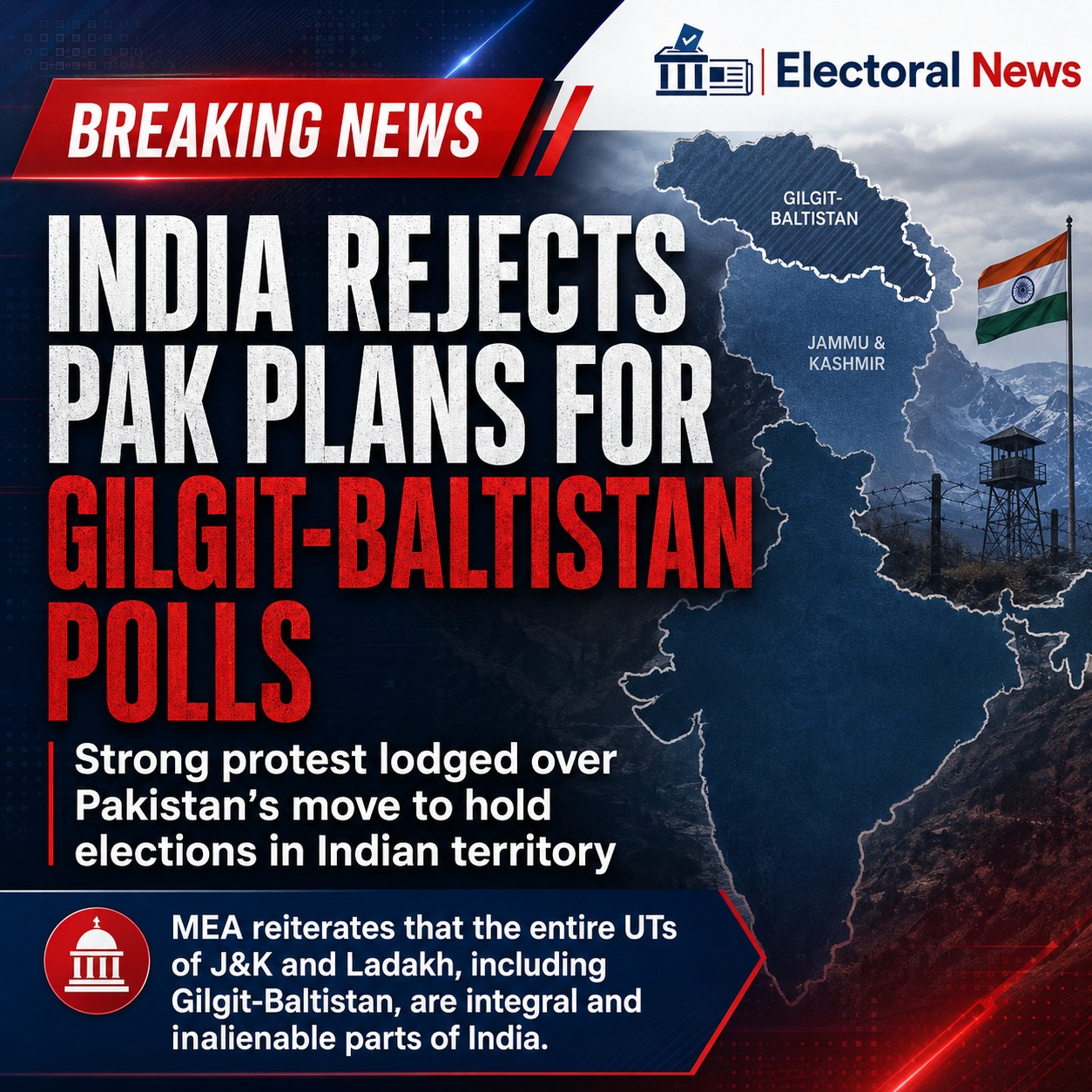
India has lodged a strong protest against Pakistan’s plan to conduct elections for the so-called Gilgit-Baltistan Assembly, reiterating that the region is part of Indian territory under Pakistan’s illegal occupation.
India has strongly objected to Pakistan’s plan to hold “General Elections” for the so-called Gilgit-Baltistan Assembly, calling the move an attempt to conduct polls in Indian territory illegally and forcibly occupied by Pakistan.According to the Ministry of External Affairs, India lodged a strong protest with Pakistan over the election plan, which is scheduled for June 7, 2026. New Delhi reiterated its long-standing position that the entire Union Territories of Jammu & Kashmir and Ladakh, including Gilgit-Baltistan, are integral and inalienable parts of India as a result of the legal accession of Jammu and Kashmir to India in 1947.
The MEA said Pakistan has no authority to conduct any political exercise in territories that India considers illegally occupied. It further stated that such actions cannot hide what India described as grave human rights violations, political repression, economic exploitation and denial of freedom in the areas under Pakistan’s control.
India also rejected any attempt by Pakistan to bring material change to the status of territories under its occupation. The government said Pakistan must vacate all areas it continues to illegally occupy, including Gilgit-Baltistan.
The issue is politically and strategically sensitive because Gilgit-Baltistan forms part of the larger Jammu and Kashmir territorial dispute between India and Pakistan. India has consistently maintained that Pakistan has no legal claim over the region and that any administrative or electoral action taken there has no legitimacy from India’s point of view.
Pakistan, however, has rejected India’s objections and continues to administer the region separately. This has kept Gilgit-Baltistan at the centre of repeated diplomatic friction between the two countries.
The latest protest comes at a time when India-Pakistan relations remain tense over border security, terrorism-related concerns and territorial disputes. New Delhi’s statement signals that India will continue to oppose any political or administrative move by Pakistan in Gilgit-Baltistan.
From India’s perspective, the planned election is not just a local political event but a sovereignty issue. By formally protesting the polls, India is sending a clear diplomatic message that it does not recognise Pakistan’s authority over the region.
The development may further increase diplomatic tension between the two countries, especially if Pakistan proceeds with the scheduled election. India is likely to continue raising objections to any move that it sees as changing the status of Gilgit-Baltistan.
For now, the central message from New Delhi is clear: Gilgit-Baltistan remains an integral part of India’s claim over Jammu & Kashmir and Ladakh, and Pakistan’s election plan has been rejected outright.
Key Highlights
- India lodged a strong protest over Pakistan’s plan to hold elections in Gilgit-Baltistan.
- The polls are scheduled for June 7, 2026.
- India said J&K and Ladakh, including Gilgit-Baltistan, are integral parts of India.
- MEA said Pakistan’s move cannot hide human rights violations and political repression in occupied territories.
- India demanded that Pakistan vacate territories under its illegal occupation.